The Rise of Hybrid Global Delivery Models: Why Smart Companies Are Splitting Operations Across Regions

For years, outsourcing followed a simple playbook:
Pick one location.Build a team.Scale it.
Today, that model is being replaced.
Not because it failed — but because it stopped being enough.
As operations grow more complex, companies are realizing that no single region is optimized for everything. What works for one function creates friction in another.
The shift is clear:
Global delivery is no longer about choosing a location. It is about designing a system.
For companies evaluating nearshore outsourcing in Honduras, this shift is not about replacing existing operations. It is about placing Honduras strategically within a broader model.
From Centralization to Functional Design
The biggest change in outsourcing is structural.
Instead of centralizing everything in one geography, companies are now distributing functions across regions based on how they operate best.
This is the foundation of hybrid global delivery.
It looks like this:
Some functions require scale and consistency
Others require speed and interaction
Others require proximity to decision-makers
Trying to force all of that into one location creates inefficiencies over time.
Hybrid models solve this by assigning each function to the right environment.
Why One-Location Models Start to Break
Single-region strategies often perform well early on.
They are easier to manage. Communication is centralized. Processes are consistent.
But as operations grow, limitations appear:
Certain teams need faster feedback loops
Some roles depend on real-time collaboration
Others require closer alignment with clients
When everything sits in one place, those differences become bottlenecks.
Growth slows not because the model fails — but because it becomes too rigid.
Hybrid models remove that rigidity.
The Core Idea: Different Work Belongs in Different Places
The strength of hybrid delivery is simple:
Not all work should live in the same geography.
Instead of duplicating operations, companies separate them by function.
For example:
Structured, high-volume work stays centralized
Interactive, client-facing work moves closer to the client
Strategic oversight remains internal or onshore
This creates clarity.
Each region has a role. Each team operates with purpose.
The result is a system that works together, not against itself.
Where Nearshore Fits in This Model
Nearshore environments play a specific role.
They are not built for maximum scale.They are built for connection.
In hybrid models, nearshore teams typically handle:
Customer interaction
Technical support
Cross-team coordination
Functions that require speed and responsiveness
This is where nearshore outsourcing in Honduras becomes highly relevant.
Honduras operates in alignment with U.S. business hours, which allows teams to work simultaneously instead of sequentially.
That changes how operations function day-to-day.
Instead of waiting, teams collaborate.Instead of handoffs, there is continuity.
Honduras as a Strategic Layer, Not a Standalone Choice
In hybrid models, each region acts as a layer.
Honduras fits as a near-client execution layer within the system.
This means:
Teams operate in sync with North America
Decisions move faster across locations
Communication feels direct, not delayed
In cities like San Pedro Sula, the concentration of business activity supports structured operations without the saturation seen in larger markets.
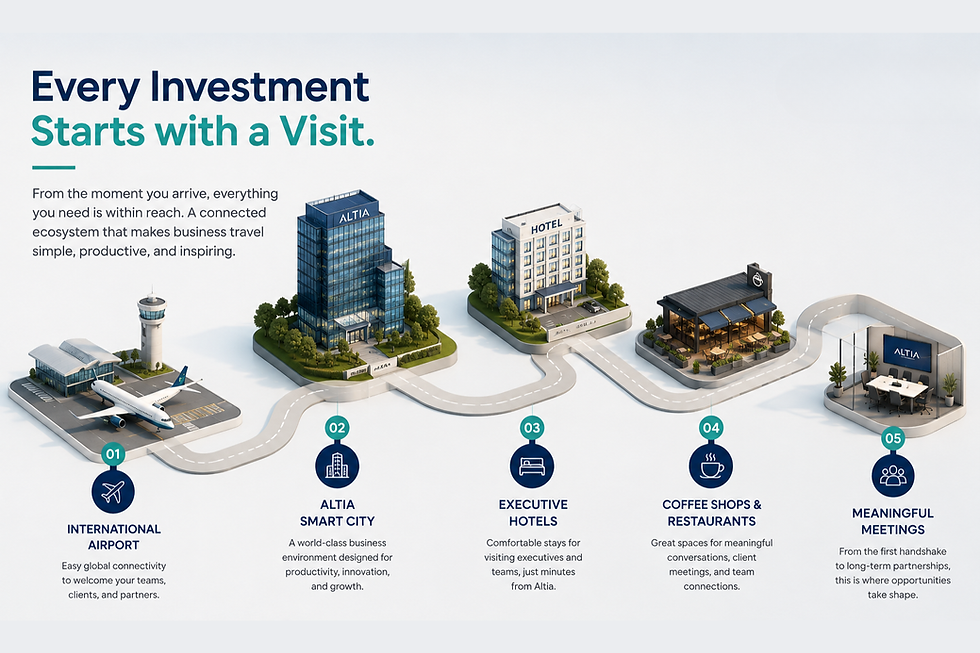
Within ecosystems like Altia Smart City, this becomes even more defined. Companies are not just operating in a location — they are operating within an environment designed for coordination.
That distinction matters at scale.
Coordination Is the New Efficiency
Traditional outsourcing focused on cost efficiency.
Hybrid models focus on coordination efficiency.
How quickly can teams align?How easily can work move between regions?How smoothly can decisions be made?
When coordination improves:
Processes accelerate
Errors are resolved earlier
Teams operate with more clarity
Nearshore environments support this because they remove barriers — especially time delays and communication gaps.
As operations grow, this becomes a performance advantage.
Flexibility Becomes Built-In
Hybrid models are not just more structured. They are more flexible.
Instead of expanding everything in one place, companies can:
Grow specific functions where they perform best
Adjust workloads across regions
Introduce new capabilities without disrupting existing teams
This creates a system that adapts over time.
Not by redesigning everything — but by adjusting parts of it.
Talent Becomes More Targeted
Different roles require different talent profiles.
Some roles need scale.Others need communication skills.Others require technical or analytical depth.
Trying to source all of this from one labor market creates limitations.
Hybrid models solve this by accessing different talent pools for different functions.
Nearshore outsourcing in Honduras adds a specific layer:
Bilingual, client-facing professionals
Teams comfortable with real-time interaction
Workforce aligned with North American operations
This complements other regions instead of competing with them.
Scaling Becomes Allocation, Not Expansion
In traditional models, scaling meant growing in one place.
In hybrid models, scaling means distributing intelligently.
Instead of asking:
Where do we add more people?
Companies ask:
Where should each function grow?
This leads to:
More balanced operations
Clearer team responsibilities
Better use of each region’s strengths
Growth becomes more controlled.
Why Hybrid Models Perform Better Over Time
At small scale, many models work.
At large scale, structure matters.
Hybrid delivery models perform better over time because they:
Avoid overloading a single location
Allow functions to evolve independently
Improve coordination across teams
Adapt more easily to change
They are not built for short-term efficiency.
They are built for long-term execution.
Final Thought: Smarter, Not More Complex
At first glance, hybrid models may seem more complex.
In reality, they are more intentional.
Instead of forcing one location to do everything, companies design systems where each part performs at its best.
For organizations evaluating nearshore outsourcing in Honduras, the opportunity is clear:
Not to replace existing operations.But to strengthen them.
Because in today’s environment, the strongest global delivery models are not the most centralized.
They are the most well-designed.