Better… For What? Rethinking Offshore vs. Nearshore Outsourcing in 2026

When companies evaluate outsourcing locations, the conversation often starts with a simple question:
Which region is better?
Southeast Asia or Latin America?Offshore or nearshore?
But that question is incomplete.
Because in global delivery, the real question is not which is better — it is:
Better for what?
Different regions are optimized for different outcomes. And in 2026, as outsourcing becomes more strategic, companies are moving away from one-size-fits-all decisions and toward more intentional, use-case-driven models.
For executives evaluating nearshore outsourcing in Honduras, understanding this distinction is critical.
Two Models, Two Strengths
Global outsourcing has evolved into two dominant models:
Offshore (Southeast Asia)
Optimized for:
Cost efficiency
Large-scale, process-driven operations
High-volume, standardized tasks
Nearshore (Latin America)
Optimized for:
Real-time collaboration
Client-facing roles
Strategic and complex operations
Neither is universally better.
Each serves a different function within a modern global delivery strategy.
Offshore Strength: Scale and Cost Efficiency
Southeast Asia has built one of the largest outsourcing ecosystems in the world.
Its advantages are clear:
Significant cost efficiency
Mature, large-scale BPO infrastructure
Extensive English-speaking workforce
For companies running highly standardized processes — such as back-office operations or repetitive workflows — offshore models can deliver strong cost performance.
These environments are built for scale.
But scale comes with trade-offs.
Offshore Limitations: Distance Creates Friction
The same factors that enable offshore scale can introduce operational complexity.
Key challenges include:
Significant time zone differences with North America
Slower communication cycles
Reduced real-time collaboration
Heavier reliance on structured, process-driven work
For functions that require speed, adaptability, or direct client interaction, these limitations can affect performance.
Distance introduces friction.
And friction becomes more visible as operations grow more complex.
Nearshore Advantage: Alignment and Agility
Latin America has emerged as a powerful alternative — not because it replaces offshore, but because it complements it.
Nearshore outsourcing offers:
Time zone alignment with the United States
Strong cultural and business alignment
Real-time communication
Increasing depth of mid-level talent
For companies operating in dynamic environments — customer experience, tech support, knowledge work — these advantages matter.
Nearshore models are not just about proximity.
They are about operational alignment.
Why Nearshore Outsourcing in Honduras Stands Out
Within Latin America, Honduras has become a strategic nearshore destination, particularly for companies serving North American markets.
Key advantages include:
Close time zone alignment with U.S. cities
Growing bilingual workforce
Competitive operating environment
Central location within Central America
In cities like San Pedro Sula, the concentration of business activity supports scalable operations.
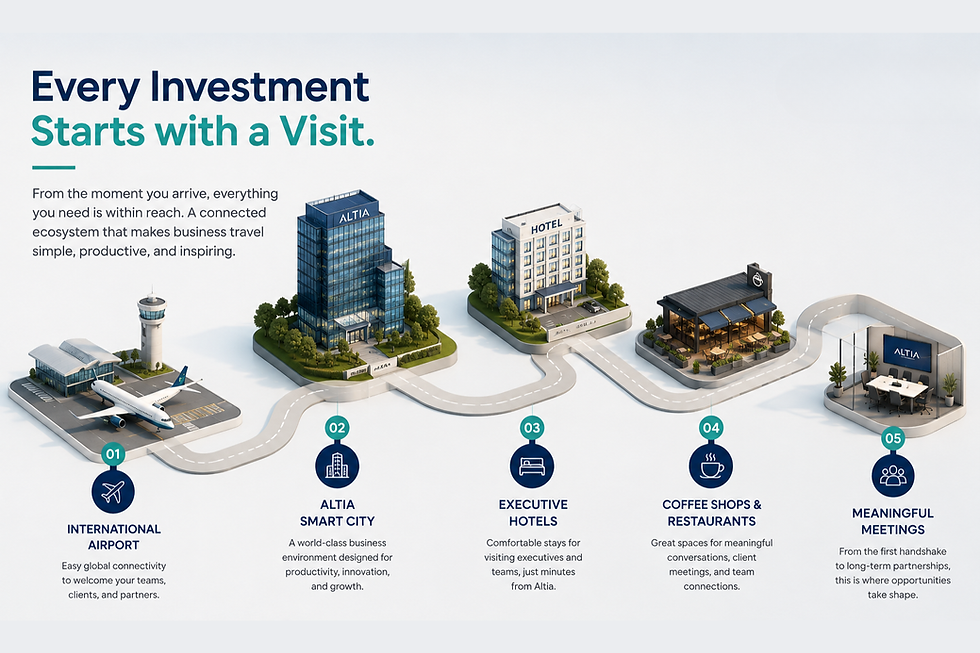
Within ecosystems such as Altia Smart City, companies operate in structured environments designed specifically for BPO and ITO growth.
This combination enables Honduras to support both operational efficiency and real-time collaboration.
Use Case Matters: Matching Location to Function
The most effective outsourcing strategies today are not built around a single geography.
They are built around function.
Best suited for offshore models:
High-volume, process-driven tasks
Clearly defined workflows
Cost-sensitive operations at scale
Best suited for nearshore models:
Customer experience roles
Technical support
Strategic or analytical functions
Client-facing teams
Roles requiring fast decision-making
This is where many companies make mistakes.
They choose a location based on cost — not based on operational need.
And that misalignment creates inefficiencies that appear later.
The Rise of Hybrid Global Delivery Models
Leading companies are no longer choosing between offshore and nearshore.
They are combining both.
A hybrid model may look like:
Offshore teams handling high-volume processing
Nearshore teams managing client interaction and complex tasks
Headquarters focusing on strategy and oversight
This approach allows companies to:
Optimize cost where scale matters
Optimize performance where speed and quality matter
Reduce risk through geographic diversification
Nearshore outsourcing in Honduras plays a critical role in this model by providing a bridge between global scale and local alignment.
Collaboration Is Becoming a Competitive Advantage
In earlier outsourcing models, cost savings were the primary driver.
Today, collaboration is just as important.
Real-time communication enables:
Faster problem-solving
Better customer experiences
More agile operations
Stronger integration between teams
Nearshore environments enable this level of interaction naturally.
Teams working in aligned time zones can operate as extensions of each other — not as separate units.
That shift improves performance in ways that are difficult to measure through hourly rates alone.
Rethinking “Better” in a More Complex World
The outsourcing landscape is evolving.
AI is transforming workflows.Client expectations are rising.Speed matters more than ever.
In this context, the definition of “better” is changing.
It is no longer about:
Lowest costLargest workforce
It is about:
Fit for purpose
Operational alignment
Scalability
Responsiveness
Nearshore outsourcing in Honduras fits this new definition by offering a balance between efficiency and proximity.
The Strategic Role of Honduras in Global Delivery
Honduras is not positioned to replace offshore hubs.
It is positioned to complement them.
As companies redesign global delivery strategies, Honduras offers:
A nearshore layer aligned with North America
Access to growing bilingual talent
A stable environment for client-facing operations
Central American positioning within diversified models
Within Altia Smart City, these advantages are concentrated into a single ecosystem designed for scalable operations.
This makes Honduras a strategic node within a broader global network.
Final Thought: Better Depends on the Objective
Outsourcing is no longer a binary decision.
It is a design choice.
Southeast Asia excels in scale and cost efficiency.Latin America excels in alignment and agility.
The most effective companies understand that both are valuable — when used correctly.
For executives evaluating nearshore outsourcing in Honduras, the opportunity is not to replace existing models.
It is to strengthen them.
Because in 2026, the question is no longer:
Which location is better?
It is:
Which location is better for what you are trying to achieve?