The Hidden Cost of Cheap Outsourcing: What CFOs Miss in Their Total Cost of Ownership Models

Outsourcing decisions often begin with a simple comparison: hourly rates.
Country A charges $12 per hour. Country B charges $22.
At first glance, the math seems obvious.
But experienced CFOs know that hidden outsourcing costs rarely appear in those first comparisons. What looks inexpensive on paper can become significantly more expensive once operational friction, attrition, compliance exposure, and governance are factored in.
Outsourcing is not a wage comparison exercise. It is a Total Cost of Ownership (TCO) evaluation. And when companies focus only on labor arbitrage instead of the full outsourcing cost structure, projected savings shrink — and sometimes disappear entirely.
For companies evaluating nearshore outsourcing in Honduras or elsewhere in Latin America, understanding TCO is the difference between short-term savings and long-term value.
Total Cost of Ownership (TCO) in Outsourcing: Beyond Hourly Rates
A proper Total Cost of Ownership (TCO) model measures every cost incurred over the lifecycle of an outsourced operation.
This includes:
Direct labor costs
Internal management time
Infrastructure and integration expenses
Attrition and retraining cycles
Quality assurance and rework
Compliance and security investments
Time zone inefficiencies
Business continuity planning
Brand and reputational risk
A well-built TCO model does not stop at salary comparisons. It evaluates long-term outsourcing ROI across operational, financial, and risk dimensions.
The real question for CFOs is not:
Where is labor cheapest?
It is:
Where is our cost structure most predictable and resilient over five years?

Management Overhead: The Invisible Multiplier in Outsourcing Cost Structure
Even when operations are outsourced, leadership responsibility is not.
Internal managers still dedicate time to:
Monitoring KPIs
Conducting performance reviews
Managing escalations
Aligning cross-border teams
Ensuring compliance standards
In fragmented offshore models, governance becomes heavy. Distance increases oversight. Cultural misalignment increases friction. Time differences slow resolution.
That oversight adds real cost to the overall outsourcing cost structure.
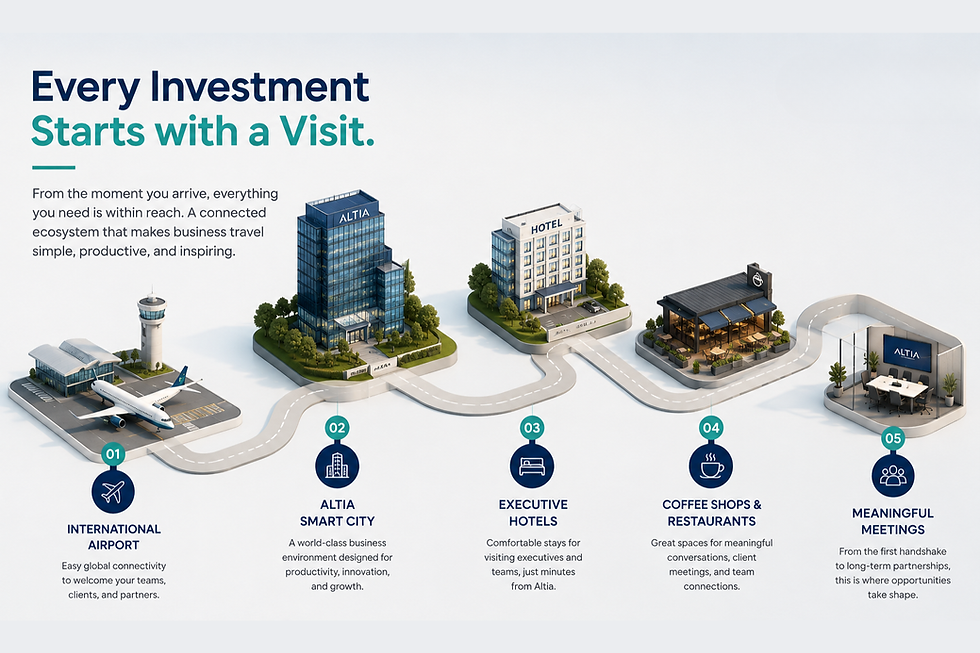
When companies operate within structured ecosystems like Altia Smart City in Honduras, management friction is reduced. The environment is purpose-built for BPO and technology operations, meaning infrastructure, utilities, and operational frameworks are already stabilized.
Less friction means fewer surprises. Fewer surprises mean lower hidden outsourcing costs.
Attrition and Retraining: The Quiet Erosion of Outsourcing ROI
Turnover is expensive.
In many global BPO markets, annual attrition can reach extremely high levels. Each departure triggers:
Recruitment costs
Onboarding time
Productivity dips
Customer experience instability
Increased QA supervision
In the BPO industry, attrition cost is one of the most underestimated components of the overall BPO cost structure.
When productivity resets every few months, projected outsourcing ROI deteriorates.
This is where nearshore outsourcing in Honduras presents a strategic advantage.
Honduras has emerged as one of Latin America’s strongest bilingual labor markets, with a growing young workforce and expanding university pipeline. Within Altia Smart City, workforce development programs and proximity to educational institutions strengthen talent continuity.
Lower attrition reduces retraining cycles. Stable teams protect institutional knowledge. Institutional knowledge protects long-term TCO stability.
For CFOs, retention is not an HR metric. It is a financial variable.
Quality Leakage: When Cheap Becomes Expensive
Low hourly rates mean little if work must be redone.
Quality leakage happens when:
Deliverables fail QA standards
Customer interactions fall below expectations
Processes require repeated correction
Rework increases internal management time. It delays timelines. It weakens client trust.
Over time, these inefficiencies inflate the true Total Cost of Ownership.
Structured, secure environments reduce variables that cause quality breakdowns. In Altia Smart City, companies operate in controlled, professionally managed facilities designed specifically for BPO and IT services.
That stability minimizes operational volatility — and volatility is one of the biggest hidden outsourcing costs.
Time Zone Inefficiency and the Advantage of Nearshore Outsourcing in Honduras
In global outsourcing cost analysis, time zone misalignment is often underestimated.
When teams operate 10–12 hours apart:
Clarifications take 24 hours instead of minutes
Escalations wait overnight
Decision cycles slow
Internal managers work outside standard hours
These delays have financial impact.
By contrast, nearshore outsourcing in Honduras aligns closely with U.S. business hours. Real-time collaboration improves:
Decision-making speed
Communication clarity
SLA adherence
Team morale
Unlike offshore models dependent on overnight handoffs, nearshore outsourcing reduces hidden outsourcing costs tied to delay and miscommunication.
Time alignment is not convenience. It is operational efficiency.

Compliance, Security, and Risk Premium in Outsourcing
Data protection regulations continue to tighten globally.
Companies outsourcing customer support, financial operations, or healthcare services must account for:
Cybersecurity investments
Data privacy compliance
Legal contract reviews
Insurance coverage
Risk mitigation frameworks
Weak infrastructure increases compliance exposure.
Altia Smart City was developed as a secure, professional business environment. Companies benefit from:
Controlled physical access
Stable utilities
Business continuity infrastructure
Established operational standards
Reducing compliance volatility strengthens Total Cost of Ownership predictability.
For CFOs, stability is often more valuable than marginal wage savings.
Infrastructure and Integration: The Hidden Setup Costs
Outsourcing does not begin at steady state.
Before productivity stabilizes, companies invest in:
Technology integration
Telephony systems
Network redundancy
Power backup solutions
Permits and facility preparation
In fragmented markets, these costs escalate quickly.
In a move-in-ready ecosystem like Altia Smart City, infrastructure is already in place. This reduces:
Setup timelines
Capital expenditure surprises
Delayed ROI realization
The faster an operation reaches stability, the faster it generates measurable outsourcing ROI.
Brand Risk: The Cost Hardest to Quantify
A single compliance failure or service breakdown can damage brand equity.
The consequences may include:
Client churn
Contract penalties
Public relations exposure
Loss of investor confidence
Cheap outsourcing that sacrifices stability increases this risk premium.
Purpose-built ecosystems reduce unpredictability. And reduced unpredictability protects brand value.
Brand protection does not appear as a line item in TCO models — but its financial consequences are real.
Why Nearshore Outsourcing in Honduras Often Delivers Stronger TCO Outcomes
When companies conduct a disciplined outsourcing cost analysis, they often find that nearshore outsourcing in Honduras provides stronger long-term value than offshore wage arbitrage models.
While hourly rates may not always be the lowest globally, nearshore outsourcing reduces:
Management overhead
Attrition volatility
Compliance risk
Time zone inefficiencies
Infrastructure unpredictability
For CFOs modeling five-year projections, predictable cost curves matter more than marginal labor discounts.
Within Honduras, Altia Smart City provides an integrated business ecosystem designed specifically to minimize hidden outsourcing costs and protect Total Cost of Ownership stability.
It is not simply about cheaper labor. It is about controlled environments, operational maturity, and scalable infrastructure.
The Strategic Shift: From Cheapest to Most Predictable
The most sophisticated finance leaders no longer ask:
Where can we pay the lowest hourly rate?
They ask:
Where is our Total Cost of Ownership most stable?
Predictability reduces:
Earnings volatility
Budget overruns
Operational disruption
Investor concern
Outsourcing remains a powerful growth lever. But only when evaluated through a disciplined TCO framework.
The hidden outsourcing costs of cheap labor compound over time. Governance, attrition, quality leakage, compliance exposure, and operational delay reshape the true outsourcing cost structure.
For CFOs and COOs evaluating nearshore outsourcing in Honduras, the smartest decision is not the lowest headline rate.
It is the model that delivers the most resilient TCO profile and the strongest long-term outsourcing ROI.