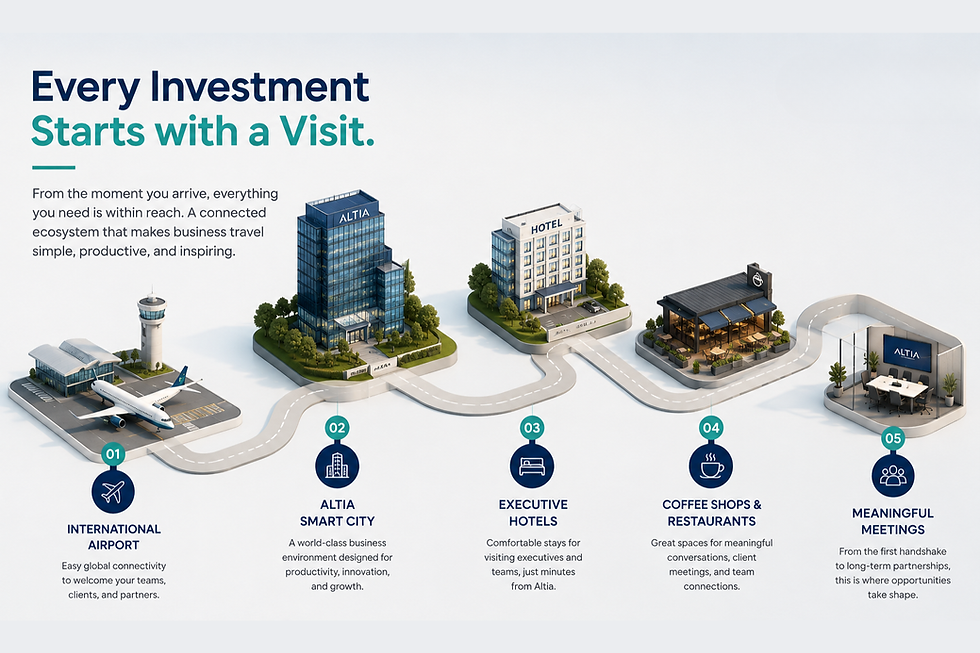
Why Innovation Clusters Outperform Isolated Companies
Why the Future of Business Is Being Built Together
For decades, companies competed primarily through internal capabilities.
Better technology. Better talent. Better products. Better processes.
Those advantages still matter.
But increasingly, another competitive factor is emerging: location within an innovation ecosystem.
Today, many of the world's fastest-growing companies are not succeeding in isolation. They are succeeding because they operate within environments where businesses, suppliers, universities, service providers, and talent continuously interact.
The ecosystem itself becomes a competitive advantage.
Innovation Doesn't Happen Alone
Innovation is often portrayed as the result of brilliant individuals.
In reality, it usually emerges through collaboration.
Ideas move faster when companies are surrounded by:
Suppliers
Customers
Research institutions
Specialized service providers
Skilled talent
Industry peers
When these groups interact regularly, knowledge spreads naturally.
A challenge solved by one organization often becomes a solution for many others.
This creates a cycle of continuous improvement that isolated companies rarely achieve.
Proximity Accelerates Decision-Making
Distance creates friction.
Long travel times. Disconnected stakeholders. Slow communication.
Innovation clusters reduce that friction.
When decision-makers, technical teams, suppliers, and partners operate within close proximity, collaboration becomes easier and opportunities are identified more quickly.
What might require weeks of coordination across multiple locations can often be accomplished in days through face-to-face interaction.
Talent Benefits from Clusters Too
People increasingly choose environments that offer more than a single employer.
Professionals want opportunities to:
Develop new skills
Build professional networks
Explore career growth
Access quality services
Maintain work-life balance
Innovation clusters create these opportunities by concentrating multiple employers, educational institutions, and amenities within the same ecosystem.
This benefits employees while helping companies attract and retain talent.
Shared Infrastructure Creates Efficiency
Not every organization needs to build every capability independently.
Within successful business ecosystems, companies often benefit from shared infrastructure such as:
Reliable utilities
Transportation access
Security
Business services
Training resources
Food and retail options
Wellness amenities
Instead of solving the same operational challenges repeatedly, businesses can focus more resources on innovation and growth.
Strong Ecosystems Build Resilience
Economic uncertainty has made resilience a strategic priority.
Companies operating within strong ecosystems often recover faster from disruptions because they have immediate access to partners, suppliers, talent, and support services.
The ecosystem becomes an additional layer of operational stability.
The Competitive Advantage of the Future
The next generation of business success may depend less on how strong a single company becomes and more on how connected it is to the organizations around it.
The most competitive locations are no longer simply places where companies work.
They are places where companies collaborate, talent develops, ideas circulate, and opportunities emerge every day.
Businesses still compete.
But increasingly, they also grow together.
The question is no longer whether companies should innovate.
The question is whether they are operating in an environment that helps innovation happen faster.
Organizations that become part of connected business ecosystems may discover that their greatest competitive advantage isn't just what they build internally—it's the network they build around them.